In-Store Kiosk System for Trading Card Singles
A singles kiosk gives customers a calm way to browse the cards your team already sells online, whether they are in the shop or standing at your event table.
Most card shops have more singles than they can show neatly at the counter. The cabinet fills up quickly, binders take time, and the rest of the range often sits in sorted boxes that customers never get to browse. A kiosk gives customers somewhere to start before they ask the team for help, so they can search, compare a few versions, and bring a more specific request to the counter.
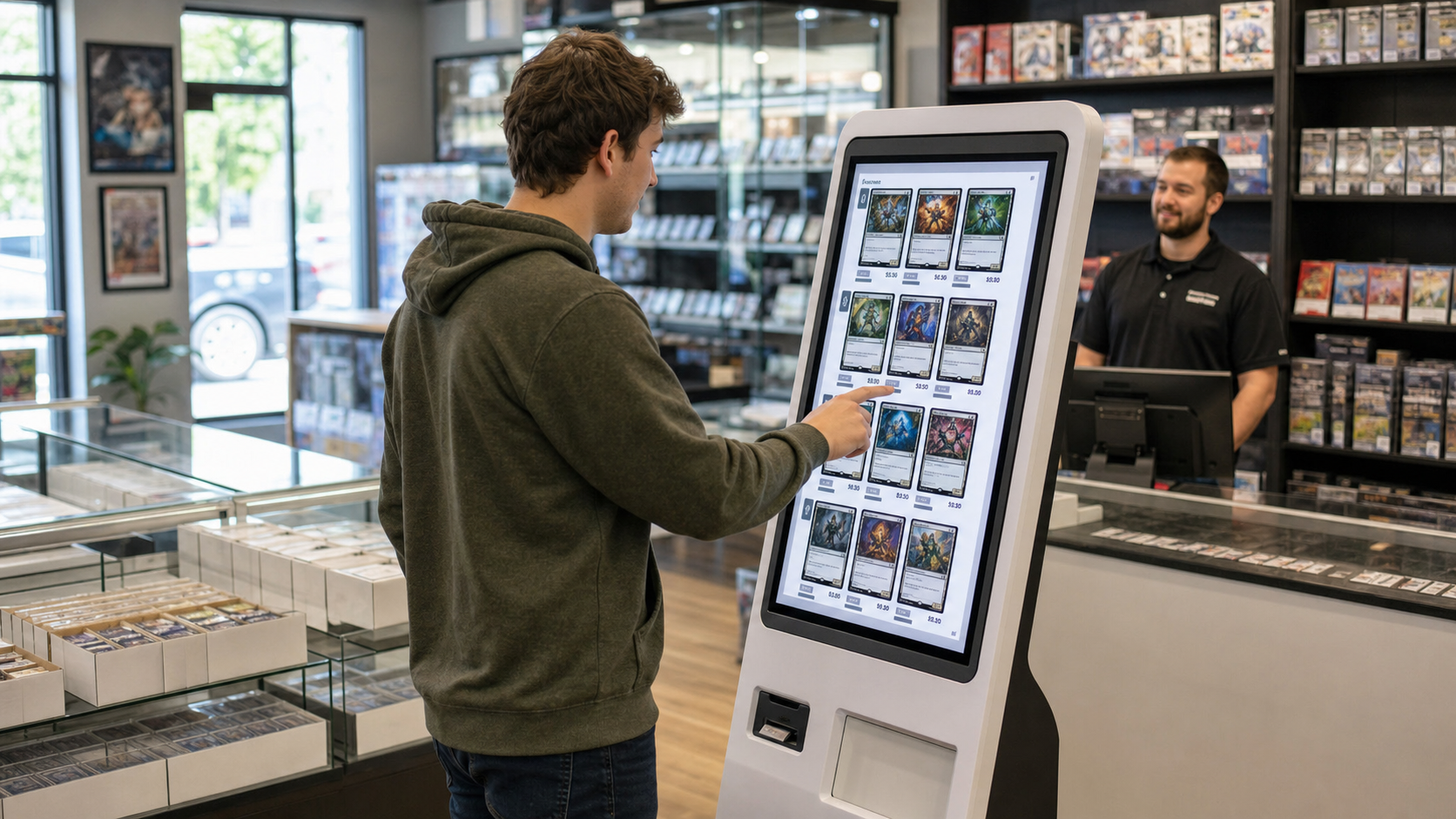
Retailers already use kiosks for this kind of work. The basic idea is simple: give in-store customers a way to browse beyond the shelf, check the details, and make a clearer choice before they need staff. TCG singles have the same shape: a glass cabinet can show the headline cards, while a Shopify catalogue can show the depth of the range.
The cabinet is still useful. It shows the cards that deserve attention and gives customers something physical to react to. The problem is space: a store might have ten times more sellable singles than it can sensibly display.
A kiosk lets the customer browse the wider range without asking staff to pull boxes for every possible maybe. This is the useful part of the endless aisle idea for card shops: customers can see stock that would otherwise stay tucked away.
Some customers know exactly what they want. Others want to browse around a deck idea, a commander, a set, or a price range. A kiosk suits that second kind of shopper because they can take a minute, change their mind, and check a few options without feeling like they are holding up the queue.
Screens are good at answering repeat questions. In a card shop, that leaves staff with the work that needs judgement: checking the copy, talking through condition, and finishing the sale.
Sealed product is easy on a screen. A booster box has a name, an image, and a price. Singles ask for more care, because one card name can point to several versions.
A player might want the cheapest playable copy. A collector might want a specific finish. Someone building a deck might only care that the card is in stock today. Customers need to see the card, the version, and the price, while staff need the stock location and enough detail to pick the right copy.
The kiosk works best as a customer-facing view of stock your team already trusts. When a card sells at the counter, the screen needs to stop showing it as available. When a price changes, the kiosk needs to follow.
When a customer asks for a card, the team needs a clear place to pick from. For TCG stores, the clean version is simple: let the screen handle the browse, then let the team handle the card.
Event tables have the same problem in a tighter space. The table only has so much room, and every box search slows it down. A tablet or small kiosk can act as the table catalogue, so customers can browse what you brought before asking to see the cards that are actually worth pulling.
It can also help with stock you would rather keep behind the table: higher-value cards, overflow boxes, or cards available to order after the show. At a card show, the hands-on moment can be as simple as letting someone search your singles before they decide what to ask for.
A good singles kiosk can be plain. The important part is clarity, speed, and honest availability. For customers, the important question is usually: is this the version I want, and what does it cost?
For staff, the follow-up is just as important: where is the card, and is it still available to sell? For TCG stores, the common question is narrow and practical: "Do you have this card, and which copy is it?" The screen should help answer that before the customer reaches the counter.
Card Companion helps Shopify-based TCG stores keep their singles catalogue ready for real store work. The same card data that supports your online store should also help staff pick, price, and fulfil orders. That keeps the kiosk easier to manage because customers get a cleaner window into the catalogue your team already uses, without a separate shop-floor list to maintain.
For stores with deep singles stock, that can be enough to change the shape of the counter. Customers browse more of the range. Staff spend less time checking basic availability. More of the cards you already own get a chance to be seen.